China Southern Airlines Review - Honest Flight Ratings
Routes Hubs at Guangzhou Baiyun (CAN) and Beijing Daxing (PKX), 200+ destinations across North America, Europe, Australia and Asia; Asia's largest airline group by fleet and passengers.
 Selina Chen 陈丽明 EN ⇄ 中文 · Frequent flyer · Trade & sourcing
 - Fares that regularly undercut Western carriers on routes into China
- Proper premium economy (38-inch pitch) on the 777-300ER and some A350s, lie-flat business on the long-haul 787, A350 and 777
- Skytrax 4-Star for seats, meals, staff service and the Guangzhou hub
- Guangzhou works well as a stopover: 240-hour visa-free transit, plus a free city tour for qualifying transit passengers
- The English website and online check-in are unreliable, third-party bookings often can't check in until the airport
- Language can be a barrier for non-Chinese speakers, which Skytrax flags too
- No alliance since 2019, so SkyTeam status no longer counts
- The cheapest branded economy fares can include fewer checked bags, or none
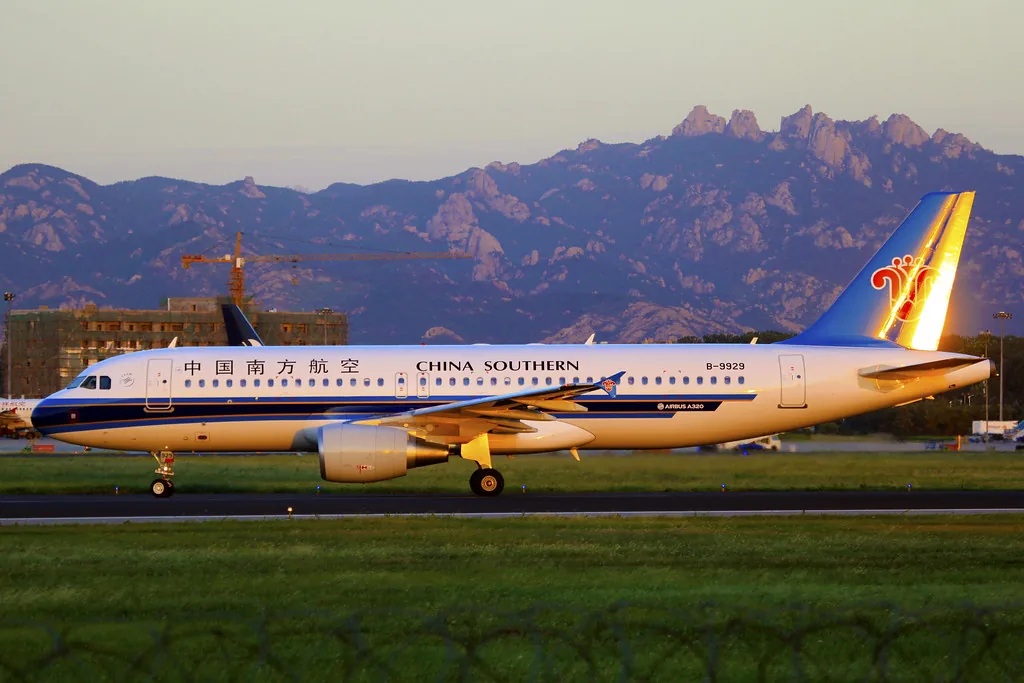
China Southern Airlines review, an overview
China Southern Airlines heads the largest airline group in Asia. Counting its subsidiaries, XiamenAir among them, the group ended 2024 with 917 aircraft and carried 165 million passengers, more than any other Chinese airline. It is state-owned, controlled by China Southern Air Holding, and runs its network from Guangzhou Baiyun with a second hub at Beijing Daxing. The China Southern-branded fleet alone is roughly 700 aircraft, flying to more than 200 destinations across North America, Europe, Australia and Asia. Outside China the name still draws a blank, which is the main reason its fares stay low.
It has a habit of buying big. In 2013 it became the first airline to fly both the Boeing 787 and the Airbus A380 at the same time. The A380s are gone now, the last commercial flight was in November 2022, and the long-haul work falls to the 787-9, A350-900 and 777-300ER. On domestic routes you may also board one of China’s homegrown COMAC jets, the C909 or the C919.
China Southern pairs low fares with a product that holds up on a long flight. Seats, meals, baggage, layovers and price all shape a trip, and a problem in any one can sour the journey. Here is how each one stacks up.
Cabins and seats, by aircraft
There is no first class on the current fleet. On long-haul you choose between economy, premium economy where the aircraft has it, and business. Which seat you get depends on the plane, so check the aircraft type before you pay for an upgrade.
- Boeing 777-300ER: the best all-round cabin. 28 lie-flat business seats, 28 premium economy seats at 38 inches of pitch and about 19 inches wide, then ten-abreast economy at 31 to 33 inches of pitch.
- Airbus A350-900: staggered business seats, every one with direct aisle access. One version adds 24 premium economy seats; another goes straight from business to economy.
- Boeing 787-9: 28 business seats. Most of the 787s carry no premium economy at all, only one sub-fleet has it.
- Domestic narrowbodies (A320 and A321 families, 737s): a small business cabin of four to twelve seats up front, and on some aircraft none.
Premium economy on the 777 is a real step up: a wider seat, a deeper recline and much more legroom than economy behind it. Economy itself is standard long-haul fare, comfortable enough for twelve hours, not generous. If you are flying on business and expect to work or sleep, pay for the lie-flat seat.
Food on board
Meals are one of the things China Southern gets right, and Skytrax rates the dining at an international standard. Expect a choice of Chinese and Western mains on long-haul, with authentic Chinese dishes the better pick, plus vegetarian options. International economy includes alcohol; domestic economy serves soft drinks only.
Special meals (vegetarian, halal, diabetic, child and the rest) have to be requested in advance: at least 24 hours before departure from mainland China, 48 hours from anywhere else. Book them online with your ticket number, or through the 95539 hotline.
Service and ratings
Skytrax certifies China Southern as a 4-Star Airline, covering the airport and onboard product as well as staff service. The rating calls the seats, amenities and dining internationally competitive, and rates Guangzhou’s handling of check-in, baggage, boarding and connections as good on the essentials. Its one consistent caveat is communication: crew are capable, but passengers who speak no Chinese can still hit a wall. On safety, AirlineRatings gives China Southern its top score.
Reviews describe the crew as efficient and polite from check-in to arrival, and English is usually good enough for drinks, meals and seat requests. For anything beyond that (a missed connection, a rebooking, a lost bag), expect to be working through a translation app.
China Southern baggage allowance
The rules turn on route and fare brand, not just cabin.
- Americas routes: standard economy fares include two checked bags of 23kg each. The cheapest branded fares can include one bag, or none.
- Other international routes: allowances vary by region and fare brand; many economy fares include only one bag, so read the fare rules before you buy.
- Business class: two checked bags of 32kg each on international routes.
- Cabin bags: one piece of up to 8kg in economy (55 x 40 x 20cm) plus a small under-seat item; business gets two cabin pieces.
- Domestic flights: weight-based rather than per piece, 20kg checked in economy.
The trap is the cheapest fare brand. It is often the one a search engine shows first, so check its bag allowance and price it against the next tier up before you click.
Connecting through Guangzhou Baiyun
Most China Southern itineraries run through Guangzhou, and the hub works. Skytrax names it as a strength, and connections are mostly handled at Terminal 2, China Southern’s home terminal.
A long layover is an opportunity rather than a sentence. Guangzhou is a port for China’s 240-hour visa-free transit: citizens of most Western countries, including the US, UK, Canada and Australia, can leave the airport and stay up to ten days without a visa, provided they hold a confirmed onward ticket to a third country or region (Hong Kong and Macau count). The permitted area spans 24 provinces, and you can travel between them, not just around Guangdong. Eligible visa-free transit passengers can also sign up for a free Guangzhou day tour, a city-funded program that has run since July 2024 (the current operator, GZL International Travel Service, took over on September 19, 2026). Book it at the service counter at Baiyun: the guided bus tour leaves Terminal 2 at 8:30am and is back by 2pm, or you take a 24-hour metro card and attraction tickets and explore on your own.
For an overnight connection on a single China Southern ticket, ask at the transfer desk about the free transit hotel. It covers one night with breakfast and the shuttle, but only for set connection windows and fare classes that the airline republishes each season.
Sky Pearl Club and alliances
China Southern’s frequent-flyer program is Sky Pearl Club. The airline was the first mainland Chinese carrier to join a global alliance, SkyTeam in 2007, and left it on January 1, 2019. It has flown unaligned since, relying on bilateral deals instead. The longest-standing is with American Airlines, which bought a stake in China Southern in 2017: the two codeshare, and since 2019 AAdvantage and Sky Pearl members have been able to earn and redeem on each other’s flights. Its 55%-owned subsidiary XiamenAir, by contrast, is still a full SkyTeam member, so check which airline actually operates the flight before you assume your status card works.
The cons of China Southern Airlines
China Southern has plenty going for it, but one thing deserves attention before you book: the website and check-in are difficult for English speakers. Some customers report the English version of the site doesn’t always work, and if you book through a site like Expedia it can be nearly impossible to check in online, you have to do it at the airport. The help of an interpreter can make this far less painful.
The language gap follows you on board and at the hub. Routine service is fine. Problem-solving is where non-Chinese speakers struggle, and on a disrupted day that means a long wait at the Baiyun transfer desk.
Is China Southern Airlines worth it?
Yes, if you book the right fare on the right plane. A 777 or A350 in premium economy is one of the better-value ways to cross an ocean into China, and the Guangzhou hub turns a layover into a free day in the city instead of eight hours at a gate. Skip the cheapest fare brand unless you travel with hand luggage only, and don’t expect miles to land in an alliance account. If you are heading into southern China anyway, this is the airline the network was built for.
Flying into Guangzhou to visit factories or the Canton Fair? Pair the flight with product sourcing support so you arrive ready to negotiate, not just to look.
Booked on China Southern Airlines? Now book the meetings.
Send your cities, dates and supplier list. You'll get a fixed written quote for interpreting and on-the-ground sourcing, no obligation, no deposit to ask.
superinterpreter · selina@mychinainterpreter.com · Xiamen, China · UTC+8