Living in Guangzhou Pros and Cons
Guangzhou is China's trading city and the cheapest of its four tier-one cities. Here are the living in Guangzhou pros and cons, from rent and the Canton Fair to the language, the summer and the housing hunt.
 Selina Chen 陈丽明 EN ⇄ 中文 · Expat guide
 Guangzhou is the city China does business in. It is the capital of Guangdong province, home to more than 19 million people, the host of the Canton Fair, and the commercial center of the factory belt that runs down the Pearl River Delta. It is also a livable, affordable city in its own right, which is why so many foreigners who arrive for a trade show end up signing a lease. This guide sets out the living in Guangzhou pros and cons with current numbers attached, so you can decide whether the move fits your work, your budget and your tolerance for humidity.
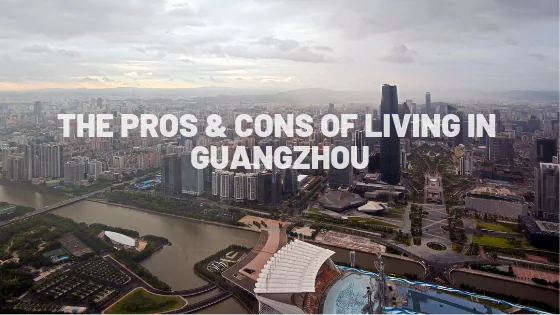
Living in Guangzhou pros and cons at a glance
Guangzhou rewards people who come here for a reason, and trade is the best reason there is.
The pros: factory and wholesale access no other city matches, the Canton Fair twice a year, the lowest living costs of China’s four tier-one cities, a metro that covers almost everywhere you need to go, the cleanest air of the country’s big national central cities, Cantonese food at every price, and 71 foreign consulates.
The cons: a long, hot, wet summer with typhoons, thinner English than Shanghai, a lot of older and tired housing stock, a short-let market that no longer includes Airbnb, and a city whose leases, invoices and contracts all run in Chinese.
The pros of living in Guangzhou
You would be moving to the heart of factory city
Hong Kong trading houses and foreign buying offices have run their China sourcing out of the Pearl River Delta for decades, and Guangzhou sits at the top of it. Foshan’s furniture and lighting, Dongguan’s electronics and toys, and Shenzhen’s hardware are all within an hour or two by road or rail, and Guangzhou’s own wholesale markets cover clothing, leather, cosmetics, toys and accessories. If your job involves buying, inspecting, shipping or selling physical goods made in China, there is no better place to be based. The border with Hong Kong is a high-speed train ride away, which makes regional trips and visa runs simple.
Getting around is cheap and easy
The Guangzhou Metro ran to roughly 780 kilometers of line by the end of 2025, with more opening through 2026, and fares start at 2 yuan. Numbeo puts a monthly transit pass at about 150 yuan. DiDi fills the gaps cheaply, and Guangzhou South station puts the high-speed network, and most of southern China, within a few hours. Most foreign residents never need a car.
There are lots of exciting and fun things to do
Guangzhou is not a museum city, but it is a good one to live in. Canton Tower and the Pearl River waterfront at night, the colonial-era streets of Shamian Island, the Guangdong Museum, and weekend walks up Baiyun Mountain cover the obvious. The food is the real attraction: dim sum, roast goose, wonton noodles, and an entire Cantonese restaurant culture built around eating out with family. The city stays up late, and our guide to things to do in Guangzhou at night covers the bars, markets and river cruises. If you are deciding between cities, our comparison of the best places to live in China puts Guangzhou alongside the alternatives.
It’s an open market for everything you want to buy or sell
The factories around Guangzhou produce for every market you can name, and the competition among them is fierce enough that prices are hard to beat anywhere else. That makes the city a natural base for small-scale entrepreneurs, whether you are developing your own product, building a private-label range, or running an e-commerce store that ships from suppliers’ stock. Clothing wholesale districts such as Baima and Shisanhang, and the electronics markets, let you see, handle and order from thousands of sellers in a day.
The trap is that the open market is open to everyone, including middlemen. Plenty of listings with a Guangzhou address are trading companies with a showroom and no production line, and the sample you approve is not always what comes off the line at volume. The importers who do well here check the business license, visit the factory floor, and negotiate in person with someone who can read the room. That on-the-ground vetting is what our product sourcing work exists for: finding the real manufacturer, checking it, and getting the price agreed before the deposit leaves your account.
The cost of living is lower than in Shenzhen or Hong Kong
Guangzhou is the cheapest of China’s four tier-one cities. China Briefing’s 2026 cost-of-living index scores it at 83 against Shanghai at 100 and Shenzhen at 90, and Hong Kong is in a different league altogether. Its estimate for a single person living a local-integrated life, meaning an ordinary apartment, local restaurants and the metro, is roughly 6,500 to 10,000 yuan a month all in.
Numbeo’s figures, crowd-sourced and updated in September 2026, tell the same story. A one-bedroom in the city center averages about 3,610 yuan a month and one outside the center about 1,860, though expat-grade buildings in Tianhe and Zhujiang New Town sit well above that average. A single person’s monthly spending before rent comes to about 3,980 yuan, and a meal at an inexpensive restaurant is about 20, so eating well on 60 yuan a day is entirely realistic. Paying for all of it is easy once Alipay or WeChat Pay is linked to your foreign card.
You will be able to visit the Canton Fair
The China Import and Export Fair, still called the Canton Fair, has run since 1957 and is the country’s oldest and largest trade fair. It runs twice a year at the Pazhou complex, in spring and autumn, each session split into three phases with different product categories. The autumn 2026 session runs October 15 to November 4, with phases on October 15 to 19, October 23 to 27, and October 31 to November 4. Global Sources’ Hong Kong shows run in April and October and overlap the fair’s first phase, so many buyers do both on one trip; in 2026 they run October 11 to 14 and 18 to 21 at AsiaWorld-Expo. Living in Guangzhou turns the fair from an expensive annual pilgrimage into a metro ride, and lets you follow up with suppliers in person in the weeks after it closes.
The air is cleaner than Beijing’s or Shanghai’s
The old smog reputation does not fit Guangzhou. The city’s average PM2.5 was 21.5 micrograms per cubic meter in 2025, with 93.4 percent of days rated good, and Guangzhou reports the lowest PM2.5 of China’s national central cities. Shanghai came in at 26 and Beijing at 27 the same year. Measured against the World Health Organization guideline of 5, though, 21.5 is still roughly four times over. Guangzhou’s air is good for China, not good for the world, and for anyone moving from Beijing it is a clear upgrade.
There is broad access to local Chinese culture
Guangzhou has been a trading port for more than 2,000 years and was the one port open to Western traders under the Qing dynasty’s Canton System, so the history here is commercial rather than imperial. You see it in the arcaded qilou shophouses of the old Xiguan district, in Chen Clan Ancestral Hall, and in a Cantonese culture of opera, tea houses and street food that has kept its own identity alongside the rest of China.
Seventy-one consulates mean the paperwork stays local
Embassies are in Beijing, but Guangzhou hosts 71 foreign consulates-general as of June 2026, which covers most nationalities. Passport renewals, notarizations and visa applications for third countries can usually be handled here rather than with a flight north. Check your own consulate’s services before you rely on it.
The cons of living in Guangzhou
Most of the people speak Cantonese, not Mandarin
This is the claim you will read most often, and it is half true. Cantonese is Guangzhou’s native language: you will hear it in the old districts, in the wet markets, on local TV and from older residents, and long-term locals switch to it among themselves. But Guangzhou is a city of migrants from every other province, and Mandarin is what offices, hotels, factories and most shops run on. The newcomer’s real problem is not Cantonese. It is that English is thin almost everywhere outside the international hotels and the Tianhe business district, so some survival Mandarin and a translation app are the daily minimum.
The business layer has a twist that catches traders out. However the meeting is conducted, the paperwork that comes out of it is written in standard Chinese: the quotation, the proforma invoice, the purchase contract, the product specification and the quality terms. A supplier can be warm and fluent with you over tea in Cantonese or Mandarin and still send you a contract whose payment, penalty and tolerance clauses say something different from what was agreed at the table. If you are here on business, it is wise to hire a translator for the documents before you sign or pay against them, and to bring someone to the meeting who catches what is said in the room. If you are a tourist, a guide covers it.
The city itself feels pretty old
Guangzhou’s showpieces are new: Zhujiang New Town, Canton Tower, Pazhou. Step off them and much of the city is older, denser and more worn than Shanghai or Shenzhen, and if you are renting on a budget you will see a lot of tired 1990s apartment blocks with dated kitchens. That older stock is a large part of why the city is cheap, and redevelopment of the urban villages is moving slowly. It cuts both ways: the old streets are also where the best food, the street life and the character of the city are.
The summer is long, hot and wet
Guangzhou sits just south of the Tropic of Cancer. From June to August, average highs run 31 to 33 degrees Celsius with heavy humidity, and roughly 80 percent of the year’s 1,700 to 1,900 millimeters of rain falls between April and September. Typhoon season peaks in August and September, usually as a day or two of torrential rain and grounded flights rather than a direct hit. Winters are short and mild, around 10 to 18 degrees in January, but there is no central heating, so the damp cold indoors is felt more than the number suggests. Our guide to the best time to visit Guangzhou has the month-by-month figures.
Airbnb is gone, and housing works differently
Older advice to book an Airbnb and move later is out of date. Airbnb shut its domestic business in mainland China on July 30, 2022 and removed its mainland listings. For your first weeks, book a hotel or a serviced apartment through Trip.com or directly with the operator; hotels register you with the police automatically, which matters more than it sounds. Take your time over the lease.
For a longer stay, most people rent through agent networks such as Lianjia and Beike, which have offices across the city, or through an agent recommended by a colleague. Expect to pay a deposit, typically one or two months, plus one to three months of rent up front, ask to see the landlord’s ID and the property ownership certificate, and photograph every room before you unpack. Then do the step most newcomers miss: foreign nationals living anywhere other than a hotel must register their address with the local police within 24 hours of moving in, either in person or through the landlord, and again after every move or re-entry. Missing it can bring a fine of up to 2,000 yuan and causes problems at visa renewal. Renting is also the realistic option, since buying property in China as a foreigner comes with residence requirements and limits.
So, is Guangzhou a good place to live?
For anyone whose work touches trade, it is the best city in China to live in, and for everyone else it is one of the easiest. You get tier-one infrastructure at a discount, cleaner air than Beijing or Shanghai, excellent food and a city that does not take itself too seriously. In return you accept a hot, wet half-year, older housing, and a language barrier that is more about Mandarin and written Chinese than about Cantonese. Safety is not on the cons list: our guide on whether Guangzhou is safe covers the petty theft and scams worth knowing, and they are the ordinary big-city kind. Come with a plan for housing, registration and the paperwork, and Guangzhou is a straightforward place to build a life or a business.
Quick answers.
Is Guangzhou a good place to live?
How much does it cost to live in Guangzhou?
Do you need to speak Cantonese to live in Guangzhou?
Can you use Airbnb in Guangzhou?
Is the air quality in Guangzhou good?
Your dates. My quote.
Twelve hours.
Send your cities, dates and product list. You'll get a fixed written quote, no obligation, no deposit to ask.
superinterpreter · selina@mychinainterpreter.com · Xiamen, China · UTC+8